Hiding drinking from kids rarely protects them the way it feels like it does. A 2020 Dutch longitudinal study of children aged four through eight found that kids internalize adult drinking norms through observation, and by age five they can accurately identify the situations where adults drink. The cups and containers adults use do not make those cues disappear.
My husband bought me an insulated tumbler for my birthday the year my middle child started kindergarten. It had the thick lid that keeps temperature for hours and obscures what is inside. I used it for coffee twice. The other five nights a week, starting around 5:55 PM, I filled it with cold sauvignon blanc and carried it around the house while I made dinner. The kids saw mom with her tumbler. They did not see mom with her wine. I thought this was a small act of devotion. Looking back, it was the first time I had to lie to myself about something I was doing in my own kitchen.
Most of what the internet has written about parents hiding their drinking comes from a rehab-center altitude, aimed at families in crisis. This post is for the mother standing in her own kitchen right now, feeling a small twist when she thinks about the word "hiding," not sure whether it applies to her.
What Hiding Drinking from Kids Actually Looks Like
Hiding does not usually announce itself. It shows up in small adjustments that quietly become part of the day.
For me, the tumbler was one piece of it. The other pieces were worse, in the sense that they took more effort and I noticed them less.
I used to time the recycling run. Wine bottles went into the bin Wednesday night, after the kids were asleep, because the truck came Thursday morning and I did not want the bin to sit full at the curb all weekend where a neighbor walking her dog could count. On weeks I drank more than I wanted to, I split the bottles between the inside bin and the garage bin so that neither pile looked dramatic. I was not thinking of it as hiding. I was thinking of it as tidying.
I poured wine into stemless glasses that looked like water glasses. I moved the open bottle from the counter to the pantry before the kids came downstairs for snacks. I told my oldest, more than once, that the smell on my breath was "kombucha" or "grown-up juice" or "wine with dinner, honey" when there had not actually been dinner yet. I said the word "just" a lot. "I just had one." "Just a little." "Just what was left in the bottle."
None of those individual behaviors is evidence of a capital-P Problem. Most are things many mothers do at some point, and the pattern I describe in my longer piece on grey area drinking covers the zone most of us are in. What matters is the pattern, and the attention you are spending to maintain it. If you are running a small logistics operation around a drink, the drink is no longer neutral in your life. The logistics are the tell.
Common patterns worth noticing:
- Pouring alcohol into opaque cups or insulated tumblers
- Timing when the recycling, the trash, or the empty-bottle run happens
- Moving bottles between bins, cars, cabinets, or neighbors
- Answering "what's in your cup" with a deflection
- Drinking a glass before a social event so the first public drink looks like the first drink
- Hiding the actual count of pours per night from yourself
- Feeling a small relief when your kids are out of the room so you can pour another
If more than two of those feel familiar, you are not in unusual company. You are a mother who is paying attention.
What Kids Actually Notice About Parents Drinking
The honest answer is: more than we want them to.
A 2020 Dutch longitudinal study in Alcohol and Alcoholism by Voogt and colleagues followed 329 children from ages four through eight. By age five, children could already identify which adult situations were normative for drinking (dinner with friends, parties, celebrations) and which were not (driving, working, caring for young children). This knowledge did not arrive through direct instruction. No parent sat a five-year-old down to explain that adults sometimes have wine at dinner. The kids assembled the picture from observation. They watched. They inferred. They generalized.
A companion 2019 paper from the same research group in Alcoholism: Clinical and Experimental Research (Smit and colleagues) tracked what shaped children's alcohol expectancies, meaning their beliefs about what alcohol does and what it means. The stronger predictor was not how much parents drank, in total volume. The stronger predictor was how often children directly observed parents drinking. A parent who drank three glasses after bedtime, unseen, transmitted fewer expectancies to the child than a parent who drank one glass at dinner, watched. What kids actually saw drove what kids actually came to believe.
There is a separate, older line of research worth naming. Cotton's widely cited 1979 review of 39 family studies in the Journal of Studies on Alcohol found that children of people who drank heavily were roughly four times more likely to develop similar patterns themselves. Later twin and adoption research has attributed about half of that effect to heritability and the rest to environment and shared experience. Genetics matter. Environment matters. The picture is not deterministic.
Here is where this lands for the mother at 5:55 PM wondering whether to pour the glass she usually pours. Her kids, younger than she thinks, are building a model of what adult stress and adult relief look like. They are building it from the cues she is giving them, whether she intends to or not. The tumbler does not make the cues disappear. It only shifts which ones they pick up.
The Shame, Secrecy, and Drinking Loop
There is a specific loop that forms when a mother starts hiding her drinking from her kids, and I want to name it plainly, because the loop itself is a big part of what keeps the pattern going.
The loop has four parts. First, drinking at a level the drinker feels ambivalent about. Second, taking small steps to keep that drinking out of view of the people the drinker most loves. Third, a low-grade, often unconscious shame about the hiding. Fourth, a pour at the end of the day that quiets the shame. That pour loops back into the first step, usually a little larger than the day before.
Shame is a high-activation emotion. When a person is carrying a baseline load of shame or guilt, alcohol becomes more reinforcing, not less. The drink does real work on the shame in the short term. It also guarantees the next round. This is how the reward system responds to predictable pain, not a character flaw.
What surprised me, when I sat with it, was how much of my drinking energy was actually going into the managing. The choreography around the drinking. The glance at the time, the bottle count, the recycling day, the breath mint, the careful story about my evening. It was its own second shift.
Once I started telling the truth about the amount, first only to myself, the loop lost some of its fuel. Not because the drink stopped being appealing. Because the secrecy tax stopped being paid.
Questions to Sit With, Not a Checklist
These are not a score. They are a quieter few minutes with yourself.
- Is there a specific cup or container I use for alcohol that I chose because it obscures what is inside?
- Would I pour the same size of drink if my oldest child walked in right at the moment I poured it?
- Have I told my kids what I was drinking was something else, even once? (Kombucha, grown-up juice, "just tea.")
- When I imagine letting my partner or a close friend see my actual weekly count of drinks, does my stomach tighten?
- If a kid asked me at 5:57 PM on a Tuesday what is in my cup, do I already have a deflection ready?
- Is the relief I feel when the kids go to bed partly about being able to drink more freely?
- Am I keeping a rough tally in my head that I already know runs low?
- Would I describe my drinking to a pediatrician the same way I describe it to my partner, to a close friend, and to a new doctor's intake form?
If several of those made you pause, you are paying attention. That is still the only diagnostic posture I trust here.
Three Concrete Next Moves
These are three moves I found actually useful, in the order that helped me.
1. Tell the truth to yourself, first. Pour into a standard five-ounce glass for one week and write down, on paper or in a note app, exactly how many pours you had. Do not interpret, do not edit. Just count. The gap between what you thought the number was and what the number actually is is the real information. In my case, the gap was about forty percent.
2. Let one person know something true. Not a full accounting. Not a rehearsed confession. Just one sentence to one person you trust. For me, it was a text to my sister that said "I've been drinking more than I want to. I'm paying attention." She wrote back "okay, what do you need?" That was the whole exchange. The relief from having one other person know was larger than I had expected.
3. Change the data before you try to change the vibe. The vibe (the mommy wine culture, the group chats, the tumbler) is sticky. The data (the pour size, the count, the time of the first pour) is movable with specific behaviors. If you try to change your feelings about drinking first, you will exhaust yourself. If you move the count down by two pours a week, your feelings about drinking begin to change on their own. The social pressure at playdates and book clubs does not go away, but it loses some of its grip once the data is honest.
Around the time I was doing the data piece, I started using the Reframe app in the evenings after bedtime. What made it stick for me was the parent-specific community that gathers inside it at 6 PM, the exact hour when our kids are underfoot and the wine habit is loudest. It is one option among several. SMART Recovery offers free science-based meetings online, Annie Grace's Alcohol Experiment is a free 30-day structured challenge, and individual therapy with a qualified clinician is always a legitimate door.
Language for When Your Kid Asks About Your Wine
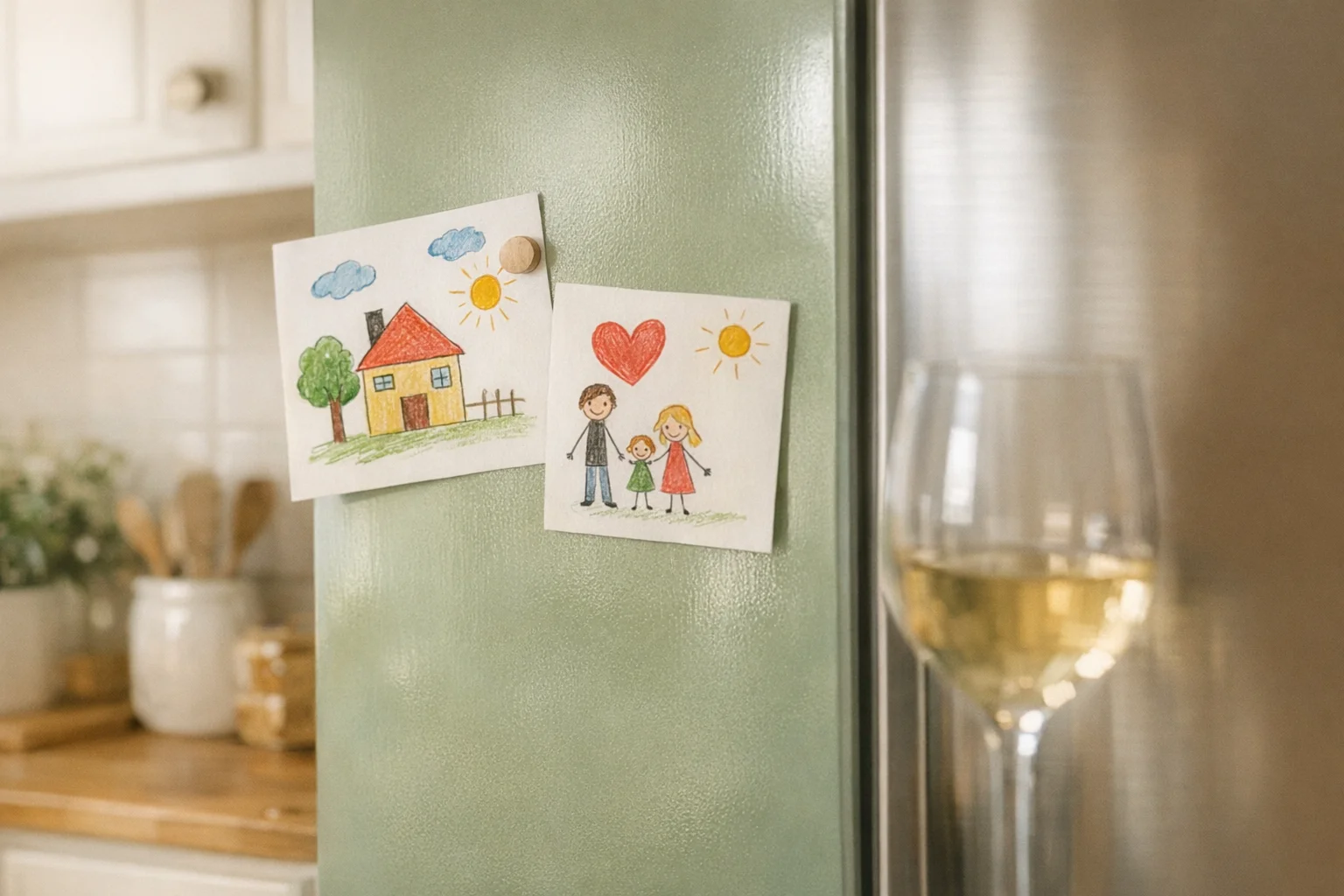
Kids ask. When my youngest, at four, pointed to my wine glass and said "what's in your cup, mommy," I froze for two full seconds before I answered. I still remember the answer. "It is wine, honey." She said okay and went back to her dinosaurs.
Age three to six: name it. "That is wine. It is a grown-up drink. You do not drink it." Short, true, calm. Children at this age are not asking an ethical question. They are just curious, and they can tell when your voice changes.
Age seven to ten: name it and answer the follow-up. "Yes, wine has alcohol in it. Alcohol is a chemical that can make people feel different. Adults are careful about how much they drink. Kids do not drink it at all." If your child asks why you drink it, a true answer is "because I like the taste," or "because I am used to having it with dinner," or, if that is where you are, "I am actually thinking about whether I want to keep drinking it." Said without drama, a kid hears it without drama.
Age eleven and up: the conversation is different now. They know what alcohol is. The honest conversation at this age is about how the adults in your family handle stress, hard days, and celebration. Your kid is calibrating her own future habits against what she sees. That is an invitation, not a threat.
What I stopped saying: kombucha. Grown-up juice. "Just a little." Anything that depended on her not knowing. She was always going to figure it out. My hiding only ever taught her to hide.
I write The Clear Mom because this is the post I wish someone had handed me eight years ago, when I had a brand new insulated tumbler and a secret I did not realize I was keeping. I was not in crisis. I was a tired mother in a culture that sold me a small, quiet habit and then sold me the lie that the habit was invisible to my kids. It was never invisible. They were always watching. The question was never whether they would see. The question was what they would see when I finally stopped pretending.
This post is written from personal experience and cites peer-reviewed research. It is not medical advice. If you're concerned about your drinking or your health, please speak with a qualified clinician.