About Amy
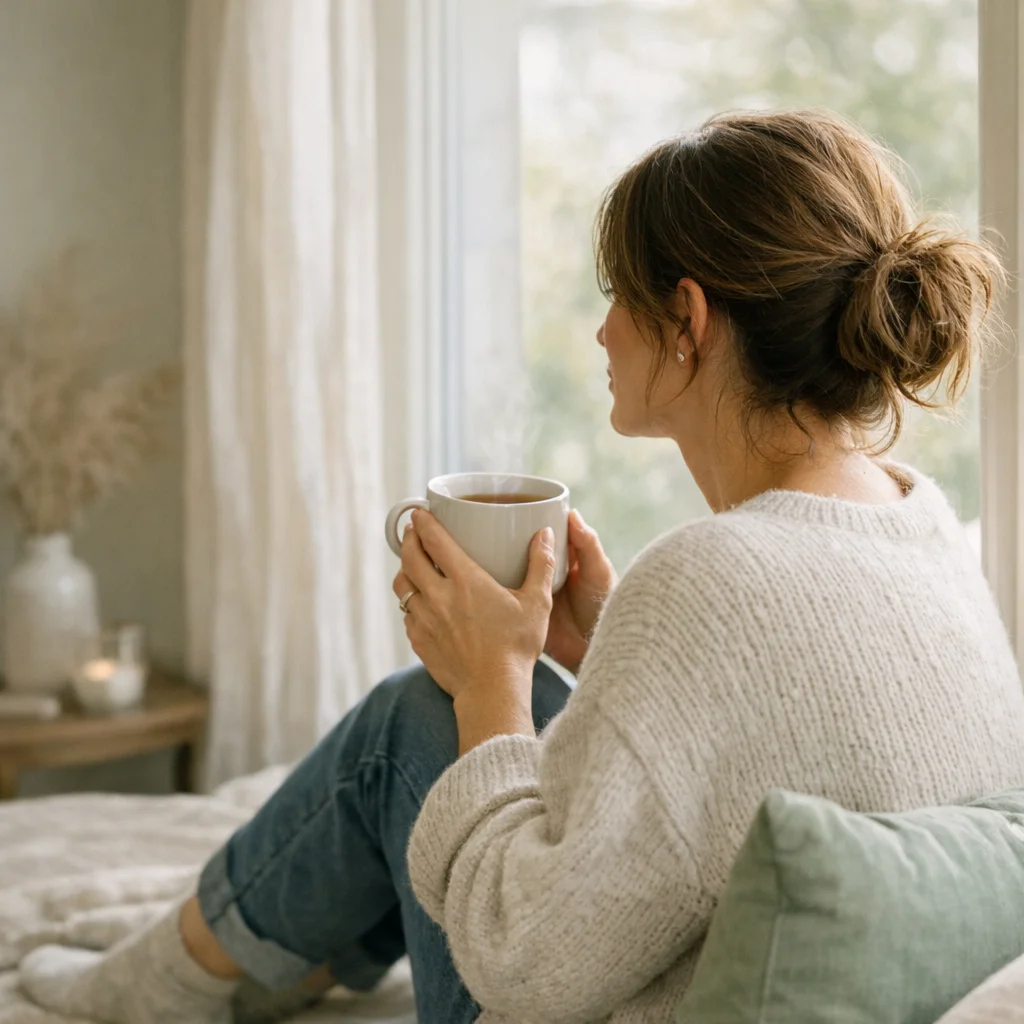
Here's the honest version.
I'm a mom of three in suburban Colorado. My kids are 11, 8, and 5. I drive a Subaru that smells like goldfish crackers. I have strong opinions about sunscreen and school lunch containers. I am, in almost every way, aggressively normal.
For years, my nightly routine looked like this: get the kids to bed, pour a glass of wine, collapse on the couch. Sometimes one glass. Sometimes three. It wasn't dramatic. I wasn't hiding bottles or missing school drop-offs. It was just... a thing I did. The way I transitioned from "mom mode" to "me mode." The way I exhaled.
Everybody did it. My friends did it. The memes told me I'd earned it. My favorite mug literally said "Mommy's Sippy Cup." It was a whole personality.
But somewhere around my late thirties, things started shifting. The wine wasn't making me feel relaxed anymore — or if it did, the feeling lasted about 45 minutes before the anxiety crept in. I'd wake up at 3 AM with my heart racing, already dreading the morning. My patience was thinner. My skin looked tired. I was more irritable with my kids at exactly the moments I wanted to be more present.
There wasn't a rock-bottom moment. There wasn't an intervention or a tearful conversation with my husband. There was just a slow, creeping awareness: this thing I'm doing to feel better is making me feel worse.
So I started researching. As one does at 11 PM when the kids are finally asleep and your brain won't shut up.
I Googled "why do I wake up at 3 AM after drinking." I fell down a rabbit hole of neuroscience studies about GABA receptors and rebound anxiety. I read about how perimenopause changes how your body processes alcohol. I discovered that the scientific consensus on "moderate" drinking had completely shifted — and almost nobody was talking about it in a way that made sense to me.
I found AA resources, which didn't resonate. I found influencers with perfect skin and book deals who made the whole thing feel like a lifestyle brand I couldn't relate to. I found clinical programs that treated every question like a diagnosis.
What I couldn't find was a resource that spoke to women like me. Moms who weren't in crisis but weren't exactly thriving. Moms who were curious, not desperate. Moms who just wanted to know: what would actually happen if I stopped?
So I started writing. First just for myself, in a Notes app at 10 PM after bedtime. Then for a few friends who were asking the same questions. Then for anyone who needed it.
I'm not a doctor. I'm not a therapist. I'm not "sober-famous" and I don't have a TEDx talk. I'm just a mom who got curious about what would happen if she stopped pouring — and started paying attention.
What happened was a lot. Better sleep. More patience. Clearer mornings. A relationship with my kids that felt less managed and more present. A 3 AM wake-up that just... stopped happening. It wasn't magic. It was neuroscience. And it was the kind of information I wished someone had given me years ago, without the judgment or the labels.
That's what this site is. Everything I learned, researched, and lived — organized in a way that I hope makes it easier for you than it was for me.
There's no test. There's no score. There's just you, getting curious. And that's already the bravest thing.
— Amy
Somewhere in the suburbs of Colorado, probably drinking tea
How I work
I'm not a doctor, a therapist, or a clinician, and you shouldn't take my word for any of this. But I do take the research part seriously — and I want you to be able to check everything I say.
Every factual claim on this site traces to a primary source. Peer-reviewed meta-analyses, primary research papers, or major health authorities (WHO, CDC, NIH, NIAAA). Never a blog, never "studies show" without naming the study, never a stat without a citation.
I distinguish science from personal experience. When I say "the research shows," I link the research. When I say "what I noticed," I'm telling you about me — one data point, not a clinical finding.
I update posts when new research emerges. Every post shows a "last updated" date. If a study I cited gets retracted or superseded, I update the post and log the correction.
I don't take money from alcohol or app companies. No sponsored posts. No affiliate links dressed up as reviews. If I recommend something, it's because I used it and it worked for me — or because the evidence base for it is strong.
This is not medical advice. If you're concerned about your drinking or your health, please speak with a qualified clinician. The information here is meant to help you ask better questions, not to replace professional care.
Full methodology, sourcing rules, and correction policy are on the editorial standards page.
The Monday Reset
A weekly email with one science-backed insight, one practical tip, and one reminder that you're doing great.
No spam, ever. Unsubscribe anytime.