You haven't become a lightweight. After 40, three things change at once: your alcohol-metabolizing enzymes (ADH and ALDH) make less enzyme per kilogram of liver, your body water drops as lean mass converts to fat so every drink concentrates harder, and perimenopausal estrogen fluctuations destabilize the liver's alcohol-handling pathways. The same wine that used to be two glasses now hits like three.
If you have been quietly asking why you can't handle alcohol after 40 the way you used to, you are not imagining it. The shift starts somewhere in the late 30s and gets steeper through the 40s and 50s. The biology, not your character, is what changed.
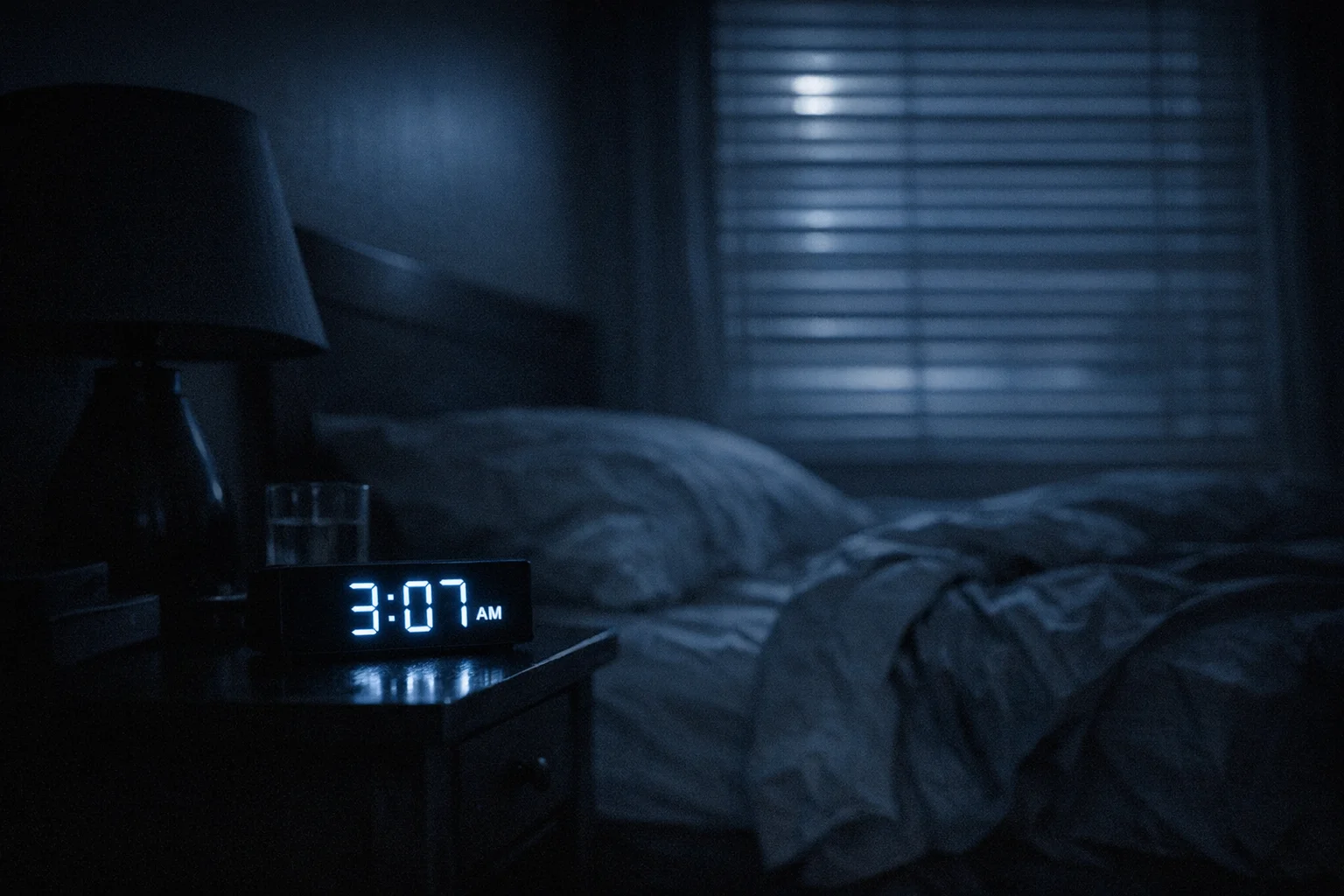
It's a Tuesday in March, and I'm at the kitchen table at 6:45 PM doing the math on a single glass of cabernet. Five and a half ounces, poured while the pasta water came up to a boil, finished by 7:20. I went to bed at 10. I woke up at 3:14 AM with my heart pounding, my mouth dry, and a low fog in my forehead that did not lift until lunch the next day. At 32, that same glass would have been invisible. At 43, it cost me a workday.
I spent the next year reading studies, talking to my doctor, and asking other moms in my pickup-line circle, and the answers came back identical. Somewhere in the late 30s or early 40s, the same drink that used to be background noise starts landing like a separate, more punishing event. The hangover that used to take three drinks now takes one. The 3am wake-up has a new permanence. The next-day anxiety arrives even if you barely had anything.
Three measurable physiological changes are stacking on top of each other inside you right now, and the research on each one is well-established. This post walks through what is happening biochemically, why it shows up at this exact age, and what to do with the information. The Clear Mom is built around answering questions like this with research first and judgment never. The fix begins with naming what is actually moving.
What Actually Changes in Alcohol Metabolism After 40
Alcohol is broken down by your body in two enzymatic steps. First, alcohol dehydrogenase (ADH) converts ethanol into acetaldehyde, which is the toxic intermediate responsible for most of what we call a hangover. Then aldehyde dehydrogenase (ALDH) converts acetaldehyde into acetate, which your body can clear. The cytochrome P-450 enzyme CYP2E1 handles a smaller share at higher doses and during chronic drinking. Together these three enzymes determine how fast a drink gets out of your system and how much intermediate damage you absorb on the way through.
Meier and Seitz, in a 2008 review in Current Opinion in Clinical Nutrition and Metabolic Care, documented that the activity of all three of these enzymes (ADH, ALDH, and CYP2E1) declines with age. The decline is incremental in the 30s and steeper through the 40s and 50s. Combined with reduced total body water in older adults, the net effect is higher blood-alcohol concentrations from the same dose and slower clearance once the alcohol is in. This is the age component of the story, and it applies to everyone, not just women.
Now layer in the female baseline. Frezza and colleagues, in a landmark 1990 paper in The New England Journal of Medicine, measured first-pass metabolism in women versus men and found that women's gastric ADH activity was 59% of men's, and their first-pass metabolism was 23% of men's. Translation: a higher fraction of every drink you swallow makes it intact into your bloodstream, before your liver gets a turn at it. Women start the race behind, and aging widens the gap.
Factor One: Your Liver's Enzyme Output Falls
The hepatic enzyme decline is the part nobody warns you about. You hit your mid-30s expecting some changes, and the conversation in most women's-health spaces stays at "your metabolism slows down," which sounds vague enough to ignore. The actual mechanism is much more specific.
Per Meier and Seitz (2008), hepatic ADH activity per kilogram of liver tissue decreases through middle age. Hepatic ALDH activity decreases too. CYP2E1, which becomes more important at higher alcohol doses and during chronic drinking, also drops. The liver itself does not shrink dramatically through your 40s, but the enzyme content per unit of liver does. The same liver, processing the same drink, is now operating with a smaller chemical workforce.
What that looks like in real time: the same glass of wine produces a slightly higher peak blood-alcohol concentration, takes slightly longer to clear, and leaves more acetaldehyde in circulation while it is being processed. None of these shifts are dramatic in isolation. Stacked across an evening, they explain why one drink at 43 produces effects that two drinks did not at 28.
Factor Two: Less Body Water Means Same Drink, Higher BAC
Alcohol distributes through total body water. The math is unforgiving: blood-alcohol concentration equals the dose divided by body water mass, multiplied by a constant. If your body water shrinks, your BAC from a fixed dose rises, even if your liver enzymes were unchanged.
Kodoth and colleagues, in a 2022 review in Women's Health Reports, documented the body-composition shift through the menopausal transition. Lean mass declines. Fat mass rises. Visceral adiposity, in particular, climbs from roughly 5 to 8% of total body fat in the premenopausal years to 15 to 20% during the menopausal transition. Because muscle holds far more water than fat, this shift directly shrinks the water compartment that ethanol distributes into.
Baraona and colleagues, in a 2001 paper in Alcoholism: Clinical and Experimental Research, confirmed that women have a smaller distribution volume for ethanol than men at baseline (about 7.3% smaller) and 42% slower gastric emptying for alcohol. The midlife body-composition shift compounds the female baseline. By 45, the same five-ounce pour that used to dilute through forty liters of body water is now diluting through closer to thirty-five. Peak BAC rises by roughly the percentage of dilution capacity you have lost. That alone explains a noticeable share of why "two glasses" now feels like three.
Factor Three: Estrogen Stops Stabilizing the Liver Pathways
The third factor is the messiest one, partly because the research is still developing and partly because perimenopausal estrogen does not just decline. It fluctuates wildly. Estrogen levels in your early 40s can swing higher and lower than they did in your 30s, sometimes within a single cycle. The liver's enzyme activity is not estrogen-blind.
Shihab and colleagues, in a 2024 narrative review in Maturitas, examined alcohol's impact across the menopausal transition and found that midlife women face increased vulnerability to alcohol-related health consequences, with mechanisms that include altered hepatic metabolism, hormonal interaction, and changes in body composition. Baweja and colleagues, in a 2023 review in Liver Research, documented that estrogen and estrogen-receptor signaling interact bidirectionally with hepatic responses to ethanol. Alcohol alters how estrogen is processed, and estrogen signaling, in turn, modulates how the liver responds to alcohol.
The practical version of all this: when estrogen is high one week and low the next, the liver's behavior toward alcohol shifts with it. The same dose can hit harder one Friday than it did the Friday before, even with the same dinner, the same hydration, the same hours of sleep. Many women describe alcohol as becoming "unpredictable" in their 40s. The unpredictability is the hormones doing what hormones do at this stage.
Why Hangovers Hit Harder, Even From One Drink
The reason a single drink at 43 can produce a real hangover comes down to acetaldehyde. When ALDH activity is slower, the toxic intermediate sticks around longer between conversion and clearance. Acetaldehyde, not ethanol itself, is responsible for most hangover symptoms.
Edenberg, in a 2007 NIAAA review, explained how variants in ALDH alter alcohol-related symptoms. People who carry the ALDH2*2 variant have markedly reduced ALDH activity, and the result is acetaldehyde accumulation that produces severe flushing, nausea, headache, and tachycardia. Wall and colleagues, in a 2000 study in the Journal of Studies on Alcohol, confirmed that ALDH2 carriers reported worse hangover symptoms than non-carriers from the same alcohol dose. The mechanism is the same one operating, more gently, in any woman whose ALDH activity has slowed with age. Slower clearance means longer acetaldehyde exposure, which means more pronounced symptoms.
That is why the headache, the next-morning fatigue, and the low-grade nausea now arrive after a single glass. You have not become more sensitive to ethanol in some mysterious way. You are accumulating more acetaldehyde for longer because the second enzyme in the cascade is slower than it used to be.
Is This Alcohol Intolerance, or Is It Perimenopause?
This is the question almost every woman in her 40s eventually asks her doctor. The short answer: it is almost certainly not the genetic kind of alcohol intolerance.
True alcohol intolerance, in the medical sense, is a genetic condition (most commonly the ALDH2*2 variant in people of East Asian descent) that has been present since birth. Symptoms appear with the first drink someone has, not at age 41 after twenty years of unremarkable wine consumption. If you drank comfortably in your 20s and 30s and then in your 40s suddenly cannot, what changed is not your genome. What changed is your enzyme activity, your body water, your estrogen environment, or some combination of all three.
There is one related condition worth knowing: histamine intolerance, which can develop or worsen at any age and is especially relevant for red wine drinkers. Red wines contain substantially more histamine than other alcohols, which can produce flushing and headaches that overlap with the hangover signature. If your symptoms are wine-specific and arrive within minutes of the first sip, histamine may be a factor on top of everything else. The two mechanisms behind alcohol-amplified hot flashes include the wine-specific histamine load if you want the longer story.
What I Did When I Stopped Trusting My Two-Glass Math
Once I understood that my "two glasses of wine" was no longer producing the same effect as my 32-year-old "two glasses of wine," I had to admit my own perception had stopped being a reliable instrument. The biology had shifted. My intuition about how much I'd had, and how I would feel the next day, was running on outdated data.
The first thing I did was actually measure my pours. I bought a five-ounce wine glass and used it. My old glass, which I had assumed was a "regular" glass, turned out to hold seven and a half ounces if I filled it the way I had been filling it. So my "one glass" had been one and a half drinks for years. Multiply that by two on a typical evening and I had been drinking the equivalent of three standard drinks while telling myself it was two.
The second thing I did was track. I used the drink tracker in the Reframe app partly because my own perception of "what I had last Thursday" was no longer matching how I felt the next day. The math had genuinely shifted, and the tracker made the shift visible week over week. Lining up the actual ounces against my next-morning energy was the first time I could see the correlation in numbers instead of vibes. It is not the only tool that can do that, but it was the one I kept opening.
The third thing I did was move my last drink earlier in the evening, which gave the slower-than-it-used-to-be enzyme cascade more time to clear before sleep. The dual cortisol and glutamate mechanism behind that 3am wake-up made it clear why a 9 PM finish was paying for itself at 3 AM, and an earlier finish bought back several hours of clearance time.
The fourth thing I did was eat a real meal first. Food slows gastric emptying, lowers peak BAC, and gives the gastric ADH (less of which I now have) more time to do its work before the rest reaches the liver. None of these change the underlying biology of perimenopause. They reduce the alcohol-specific layer that the biology amplifies.
For the broader picture of why alcohol shifts so dramatically in midlife (estrogen, sleep, metabolism, and the cumulative load all interacting), I covered the broader perimenopause factor and why alcohol hits different after 35 as the entry point to this whole cluster. This post is the metabolism-specific deep dive. The hot-flash, sleep, and anxiety pieces each take one downstream system in turn.
This post is written from personal experience and cites peer-reviewed research. It is not medical advice. If you're concerned about your drinking or your health, please speak with a qualified clinician.